Today, for the last time at the museum, we finished making the finding aid for the collection. Since we had already collected all the information in the spreadsheet, it was very easy to just take the information from the metadata to make the finding aid for researchers. We had worked on it some the last day we had been there, but we were able to finish a finding aid for the 1930s, 1940s, 1950s, 1960s, and 1970s. Since we were not able to get the 1980s and 1990s cataloged, someone else will have to make the finding aid. I hope the finding aids will be useful for people wanted to search the collection.
I have really enjoyed my time working at the BBRM and I think all the things I have experienced will help me in my future life as a librarian. I think the most important thing I learned was the importance of organizing materials in the most logical way. If the materials aren't organized well, researchers would have a harder time using teh collection adn might not find the information they need.
Showing posts with label Directed Study. Show all posts
Showing posts with label Directed Study. Show all posts
Friday, December 4, 2009

Tuesday, November 17, 2009
Week Nine, Day Fourteen- November 16
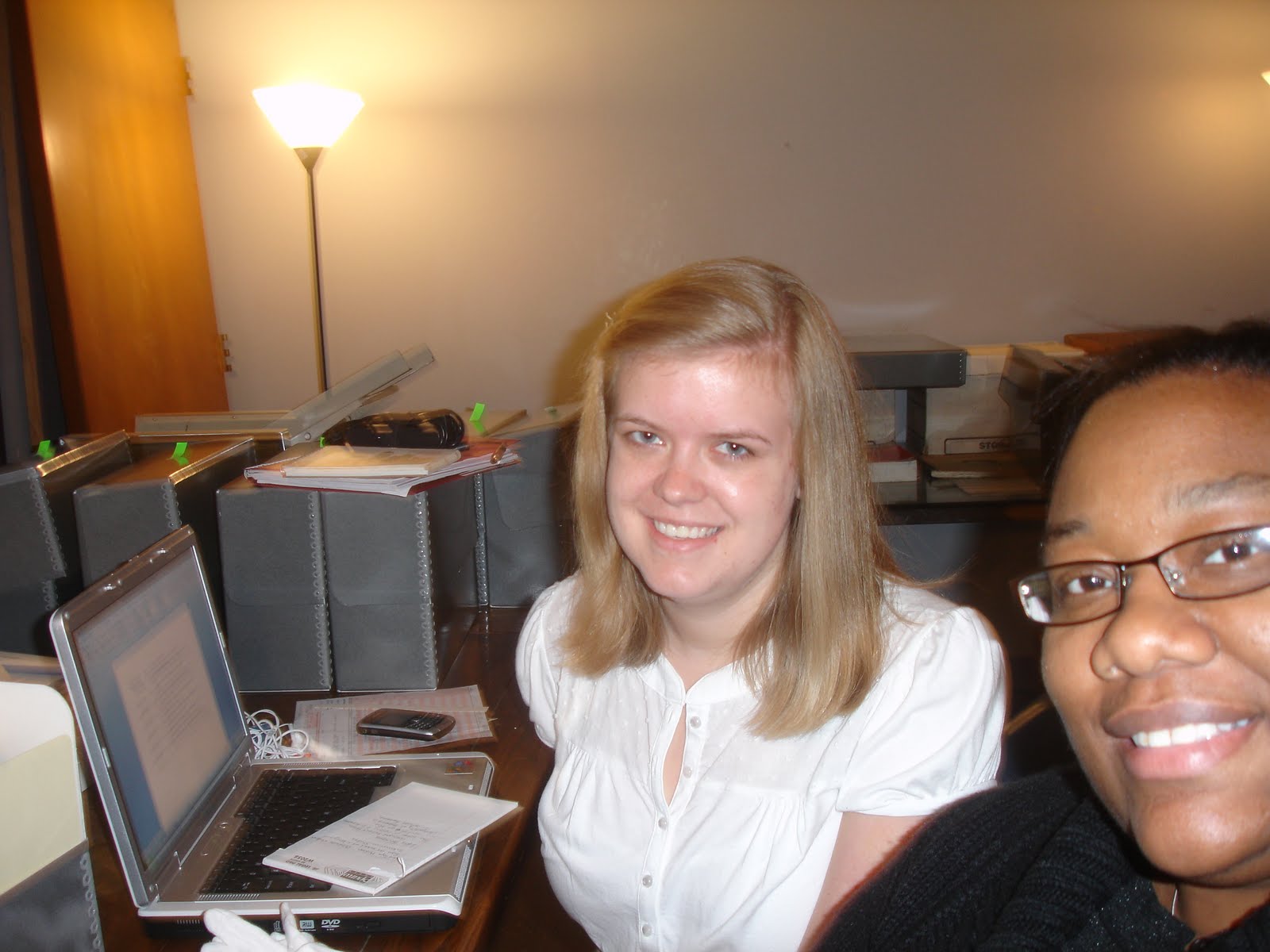
Oh, the last day of the directed study before Thanksgiving! So, today we had a rather productive day and we finished all the 1970s pictures and started and finished the 1970s papers and documents. I really think that practice makes perfect and we are just getting so much faster at all the cataloging. We seem to be having the same problem of pictures not being organized in the best way, but hopefully someone will be able to go back and fix this problem. I just can't believe we were able to work as fast as we did today. Maybe its because we are so ready for Thanksgiving! It is kinda sad that it took this long to get into a good rhythm, but better late than never!
Week Eight, Day Thirteen- November 13
Today we were able to finish the pictures for the 1960s. The pictures for this decade took up one whole filing box! I was really surprised we were able to finish today because there were just so many pictures to catalog. As we worked, I began to notice pictures that should have been grouped together because they were of the same event, but we had failed to place them together. I'm thinking that if we have time, we might be able to go back and put the pictures in a better order and just rework the spread sheet, but I doubt we will have the time. It really surprises me that this happened because we spent so much time at the beginning of the project trying to put the pictures in the most logical order. I think the reason behind the mix up is that two people have been working on everything at the same time. When you are able to work on your own, you get to handle each picture and you would be able to make connections that are just not made when two people are handing the pictures.
I think in the future, anyone who works on the collection should just work on one decade at a time on their own. This way they would get to know the decade and could make connections between different pictures.
We were also able to finish the paper work for the 1960s today. It didn't take us that long because we have found a good system of getting through all the paper work. While I type the information into the spread sheet, Latoya gets all the papers in the next folder in the best order and reads over everything. She is then able to give me a brief overview of the information so that I don't have to read everything to find out what should be included in the spread sheet. I think working with a partner works for papers and documents but not so much for pictures.
Tuesday, November 10, 2009
Week Eight, Day Twelve- November 9

So today we began working on the 1960s material. I can't believe how many head shots are in the collection for this decade. We spent the day working on just photos and hopefully we will be able to finish them the next day we come. The photos in this collection had more information written on the back, I'm guessing because more of these people are still around and Bob has been able to speak with them about their experience in the black radio industry. I think as the collection develops there will be more information added to these materials as more people find out about the project and are able to add any knowledge they possess. I really do hope that anyone who works on this project in the future is able to talk with the people in the photos and get all the information they have about this time in Birmingham history because it would be a real shame to lose what they know.
Monday, November 2, 2009
Week Seven, Day Eleven- November 2
Today we were able to finish up processing the 1950s collection. Most of the documents of the 1950s are newspaper articles which I really enjoyed reading as we processed them. Several of the articles were about racial issues in Birmingham and how people tried to shut down several of the black radio stations. There were also several instructional manuals for various radio devices from the 1950s. We processed them along with the rest of the materials, but I am having a hard time thinking of reasons that someone might want to look at them in the future. Well, maybe someone could use them if they were trying to repair an old piece of equipment. There are also several radio devices that Bob would like us to catalog and the instruction manuals might go to them. I definitely think we will need Bob's help in trying to figure out the name of each device.
As I looked back on some of the metadata that we worked on previously, I noticed that I did not include the newspaper article title for some of the articles. This was a huge mistake and I will need to go back and fix it the next time because what good is this description "WBCO newspaper article from Nov. 11, 1958"? Nothing, that's what.
As I looked back on some of the metadata that we worked on previously, I noticed that I did not include the newspaper article title for some of the articles. This was a huge mistake and I will need to go back and fix it the next time because what good is this description "WBCO newspaper article from Nov. 11, 1958"? Nothing, that's what.
Week Six, Day Ten- October 30
Today we worked towards finishing the metadata for the 1950s. I really thought that since we finished the pictures the last time we worked, but we would be able to finish the documents in one day. No such luck! There was just so much to look at and type. The processing goes so much faster with pictures because there is only a little bit of information that you need about a picture, who is in it, what year was it taken, and in the case of this collection, to what radio station does it relate? Well, the same can not be said for documents.
I think it takes almost twice as long to catalog a document than a picture. I think this is mostly due to the fact that I enjoy reading most of the newspaper articles and some of the letters to get a better feel for how to describe them in the metadata. But its difficult to write a description because there is just so much information in most of the documents that a little line in a spread sheet. I don't think its good to overly describe the document because then things get too wordy and it might make it difficult in searching by research for items of interest. I think with practice I'll get better at making precise descriptions for documents like I can for photos.
I think it takes almost twice as long to catalog a document than a picture. I think this is mostly due to the fact that I enjoy reading most of the newspaper articles and some of the letters to get a better feel for how to describe them in the metadata. But its difficult to write a description because there is just so much information in most of the documents that a little line in a spread sheet. I don't think its good to overly describe the document because then things get too wordy and it might make it difficult in searching by research for items of interest. I think with practice I'll get better at making precise descriptions for documents like I can for photos.
Wednesday, October 28, 2009
Week Six, Day Nine- October 26
Today we continued to work on the materials from the 1950s. There are just a ton of photos in this collection! Most of the photos were head shots or promotional photos of various radio personalities which I think is interesting, but I'm not sure how it would be helpful to researchers unless they were just looking for a picture of a particular radio personality that they had already researched. Whenever I work on processing a collection, I always like to imagine the ways in which researcher might be able to use the items in the collection. I guess I just haven't thought hard enough to discover the ways in which this collections will be used, but I'm sure that I will come up with something. When I first started to work on a collection at the archive at the university, I hard a very difficult time thinking of ways someone would want to use the materials I was working with, but as time went on, I began to see the value in the items and the entire collection. I'm sure with time I will be able to think of something.
We were able to finish up the pictures today and go a start on the documents. I find this to be much more entertaining and interesting because some of the letters and newspaper articles really tell the story of the development of black radio in Birmingham and other cities in the United States. I especially enjoyed looking at various Federal Communication Commission reports because they give facts and figures to the overall history of black radio.
We were able to finish up the pictures today and go a start on the documents. I find this to be much more entertaining and interesting because some of the letters and newspaper articles really tell the story of the development of black radio in Birmingham and other cities in the United States. I especially enjoyed looking at various Federal Communication Commission reports because they give facts and figures to the overall history of black radio.
Sunday, October 25, 2009
Week Five, Day Eight- October 23
Today we continued to work on creating a metadata spread sheet for the collection. Since we had finished the 1930s and 1940s, we began working on the 1950s. There is a lot more material for this decade so it will probably take us at least another day of working to finish it up. There are a lot more photos in the this collection and many of them are head shots of various radio personalities. It looks like Bob or someone else has written names and dates on some of them, but we will have to talk with him after we finish processing all the materials to find as much information about each item as he has. I'm also beginning to think about ways that we can put information that Bob might not be totally sure about into the metadata. If he thinks he knows who is in a picture, but isn't totally sure, we don't want to put that into the description field because it might end up being wrong and that might lead a researcher down the wrong path. But it could be right and we wouldn't want to exclude information we are not sure about.
This issue is something that the world of metadata must work on and try to figure out a solution. When one is processing a collection and making the metadata, you can't put in information that you are unsure of, but you also don't want to leave it out. It would be helpful to develop a field within the metadata schema that would also a person to include information but make sure the patron or researcher know the information may or may not be correct. It would also be helpful to let users make additions to metadata, but this also could only be done if the information is displayed in such a way as to make it clear it came from the public rather than the archive itself.
This issue is something that the world of metadata must work on and try to figure out a solution. When one is processing a collection and making the metadata, you can't put in information that you are unsure of, but you also don't want to leave it out. It would be helpful to develop a field within the metadata schema that would also a person to include information but make sure the patron or researcher know the information may or may not be correct. It would also be helpful to let users make additions to metadata, but this also could only be done if the information is displayed in such a way as to make it clear it came from the public rather than the archive itself.
Thursday, October 22, 2009
Week Five, Day Seven- October 19
I felt like today was one of the most productive days that we had at the museum. Since most of the photos had made it into protective sleeves, we were able to move on to the actual cataloging of the images and papers. We began with the 1930s since this decade had the least amount of materials. At first we started out with the unique identifier system that Latoya and I had developed earlier, but as we worked, we found that it really wasn't going to work for the needs the collection. At first, we thought that we should work each individual radio station into the number, but this became a problem because some of the materials were not related to any one radio station. This caused us to drop the radio station from the system. So, our final unique identifier number will look like this 0002.0002.000001. The first number tells you what type of material the item is, whether its a picture, manuscript, or recording. The next number tells you what decade the item is from and the last number is the individual item's number within each collection. We were able to make a spread sheet for the 1930s and 1940s. Once we have made a spread sheet for each decade and given each item its own unique identifier, Latoya and I are going to sit down with Bob and have him give us as much information about each piece as he can. We will use this information to refine the metadata and to create a finding aid that can be used by researchers or other interested persons.
Week Four, Day Six- October 16
Today, more archive materials from Gaylord arrived so we were able to finish putting all the photographs into protective sleeves and finish putting all the manuscripts into their own folders. Even though this process takes forever, I think it is really important because we want to know this collection as well as we possibly can before we begin the cataloging process. Not taking the time to get to know the collection can have a very negative affect on the final product of a finding aid because we would not be able to link up similar materials so that it is easier for a researcher to find the information they are looking for. I know it can be very frustrating when you don't have any idea the proper chronology for a collection and you are forced to make one up by yourself. Because a collection may no longer be in the correct order, it is so very important to take the time to look at each item, both as an individual record and as the item relates to the rest of the collection. If the person developing the finding aid does not take the time to match similar materials, a researcher may find it difficult and frustrating to use the materials. It really is up to the person who is working one on one with the materials to take the time to put them in the most logical order possible. I hope that all the time we are spending looking at the materials as we put them in protective sleeves and folders will enable us to develop the most logical system for organizing everything which will lead to a well thought out and developed finding aid.
Wednesday, October 14, 2009
Week Four, Day Five- October 12
Today we were able to get into the workroom and spend most of the time putting pictures into the protective cases. We then moved on to putting all the transcription disks into folders. This gave us a chance to see what kind of recording we will be dealing with. As I understand it, each transcription disk contains a radio program that was recorded at an earlier date, then played by different radio stations at different times. They seem to be the almost like a re-run of a radio program. I really enjoy getting to go through all the materials and find out what types of materials make up the beginning of the museum.
Since it was a some what slow day, we were able to talk more about the cataloging process. I hope that we will be able to get through all the materials and make a metadata spread sheet for each collection and then take that information to make a finding aid.
Since it was a some what slow day, we were able to talk more about the cataloging process. I hope that we will be able to get through all the materials and make a metadata spread sheet for each collection and then take that information to make a finding aid.
Monday, October 5, 2009
Week Three, Day Four- October 5
Today was a rather slow day at the directed study because we were unable to get into the project work room. Although we had no chance to work with the materials, Latoya and I decided that we would use this time to begin to develop a mission statement for the museum and a collection development policy that can be used as more materials are added to the collection.
Here is what I came up with as the mission statement. "The mission of the Birmingham Black Radio Museum is to collect and preserve materials relating to the history of African-American radio in the city of Birmingham, Alabama and the surrounding areas." I feel like this is a good mission statement because it is simple and it lays out exactly what the museum is, or at least what it wants to become.
The collection development policy is also a vital part in the beginning of an archive or museum.
The museum will collect any materials relating to the history and development of black radio in the city of Birmingham, Alabama and the surrounding areas. The museum is most interested in collections materials that explain the history of specific black radio stations in the Birmingham area.
Materials to be collected
• Newspaper articles
• Photographs of radio personalities
• Photographs of radio sponsored events
• Oral histories from persons who were active in the development of black radio in the Birmingham area.
• Manuscripts from radio stations
• Manuscripts from radio personalities
• 3-D artifacts from radio stations
I feel like this is a good collection development policy because it is simple and includes all types of materials that the museum might want to collect. It lays out specifically what materials the museum wants so there will not be any problems with what to do with irrelevant materials.
Tuesday, September 29, 2009
Week Two, Day Three- September 28
Yesterday was a super exciting day at the ol' directed study because we got in a bunch of supplies and materials. It was like Christmas, only instead of toys and games, Santa had brought boxes of folders and protective covering for photographs. It was really nice to be able to spend the whole day putting everything in nice, protective plastic. This also gave us the chance to look over the collection again, because its always important to know your materials before you start the cataloging process.
In addition to getting everything into protective cases, my directed study buddy, Latoya and I discussed the possibility of making some type of exhibition. Nothing too fancy or complex, just a little one so we could get some experience putting one together. The collection we are working with presents two different topics for display. The first, which I think would just look great, is a display of the large collection of sheet music that is part of the collection. I think we could pick maybe 20 pieces and make a really nice display. The other idea was to make a display with all the head shots of radio personalities and call it "Voices of Black Radio." I like both ideas and we might be able to make two displays. I think they could be very useful in promoting the museum and getting the word out.
Making a display would, I think, be very interesting and great practice for the future. We would get to discuss what types of materials would work best for our given topic, learn how to construct the display, and do research on the particular topic. I hope that before the end of the semester, we will be able to at least do one small display.
Friday, September 25, 2009
Week One, Day Two- September 25

Today at the Birmingham Black Radio Museum I developed a unique identifier system for the collection. I began by looking at a system that is used at the Hoole Special Collection to see if it could be a good jumping off point to begin the development of one that would work for the collection. The Hoole system is made up of three parts, the first number is used for the identification of the type of material being cataloged, whether it is a photograph, recording, or manuscript. The second number identifies the collection name, like the Wade Hall Small Collection. The last number is the used to identify a specific item in the collection. There is also a fourth number, but it is only used if an item is more than one page long if it is a manuscript or if it is over one tape long if it is a recording. The final number for an item in the collection looks something like this 0003_000056_000001_0001. If I wear looking at this unique identifier, it would tell me all the basic information I would need to know, what kind of item is it, what collection does it belong to, and how long it is.
Using this as a jumping off point, my directed study buddy, Latoya, and I began brainstorming what kind of information would be important to include in the unique identifier for this collection. While talking with Bob Friedman, he informed me that he would like to see each radio station have its own collection, so we began the number with the four letter call sign of each radio station. The next piece of information that needed to be address in a unique identifier is the type of material being cataloged. The material type will be identified with a four digit number to correspond with each material type in the collection, manuscript, photograph, voice/ sound recording, newspaper clipping, and so on. Next, each decade will be broken down within the collection to make almost a mini collection within the larger one of the radio station. Bob asked if this could be done to make using the materials by year easier for anyone doing research. The unique identifier system at Hoole does not have any numbers that correlate with the year the item was created, but I believe that is because their collections are so far ranging that putting the year in the collection would not make sense or work for them. The last number in the collection will used to identify each item within each collection. This number will be eight digits long to ensure that the collection never outgrows the numbering system. There is also a final, four digit number that will be used only if an item has more than one page.
I think the most important thing I learned today while developing this numbering system was to really think about what types of materials you are trying to catalog and organize and then use that information to inform your system. If I had just used the same system as the one at Hoole, I would have had a hard time making it work for this collection and its specific needs. I think as we work more with the materials and prepare them for the creation of metadata, we might have to change the system a little, but as I see it now, I think it will work well with the collection and serve all the needs the collection will have for a unique identifier system.
Tuesday, September 22, 2009
Week One, Day One- September 21

Today was my first full day at what will become the Birmingham Black Radio Museum. My directed study buddy, Latoya, and I spent the day going through much of the collection to get a feel for what we would be working with for the next semester. We went through so many folders of photos and letters! A good deal of the materials had names and a few had dates, but the museum project director, Bob Friedman said that he knew who almost everyone was in the photos or he would be able to find out. It will be so nice to have a resource that will be able to identify a great majority of the people related to the collection.
As we went through the collection, we took note of what types of materials and what would be needed to organize and preserve them. Most of the collection is made up of photographs and luckily, none of them seem to be too deteriorated, so hopefully once we get them into protective casing they will last a long time.
After we finished going through everything to get a feel for what was there, we made a list of tasks that we need to complete to get a good start of the collection becoming a museum and being useful for researchers.
1. Organize and group like materials
a. By radio station
b. By decade
2. Place in protective cases and folders
3. Develop a unique identification system for the collection
4. Migrate materials into new technology
5. Begin to catalog
6. Create metadata
7. Scan materials into a computer
I’m not sure how far we will get in this list over the course of the semester, but I think that we will be able to at least organize the materials, develop a unique identification system, and being the process of cataloging and creating metadata. I really want to get to this stage in the process because it is my favorite part of the archival process as the metadata opens the materials up to be searched and used to their full extent.
I think in order to get the most out of this experience; it would be good for me to read some materials about the creation of unique identification systems in order to create the best one for this collection. If might also be very helpful to find out as much about the history of black radio in Birmingham. This would give me a better idea of what I was looking at when we get to the creation of metadata because you always want to know as much about a collection as possible before arriving at this stage.
Thursday, September 10, 2009
I'm Ready!!!
Next week, I really get to start my directed study. I can't wait. When I first visited the future Birmingham Black Radio Museum, I was a little nervous, but the closer I get to starting, the more excited I am about the whole experience. I am currently in a class about archives and today we had a great guest speaker from the Paul W. Bryant Museum. Hearing him talk about the museum and all their collections really got me excited about working to get this project started. I know its a very long way away from being as good as the Bryant Museum, but it was really interesting to see what might be.
Monday, August 31, 2009
1st Day
Today was my first day of a directed study that I will be doing over the course of this semester. I will be working at the Birmingham Black Radio Museum. Right now, the museum is more of just an idea than an actual museum. The idea for the museum came from the owner of WJLD, Gary Richardson, and its manager, Bob Friedman. I am really looking forward to working on the archives that will become part of the museum. Right now everything is just in boxes and there has been some organization by the person who is spearheading the idea for the museum, Bob Friedman. At this point, it is my understanding that the collection for the library contains several transcription disks, which is how radio programs were recorded and shared back in the day, some radio catalogs, sheet music, pictures from the history of several black radio stations, and other papers that have been collected that tell the history of black radio in Birmingham.
The project is a very long way from becoming a museum, but I think it will be really fun to get in at the ground level of the project and hopefully see it grow into a full fledged museum. It seems like the first thing that we will be doing is get all the materials into archive safe containers and folders. The most important thing right now is to make sure that the materials in the collection are preserved and are not allowed to deteriorate any more. Then we will get to begin the organization process. Much of the materials are already organized to some point, but I think that they will need more work. This has always been my favorite part of the archiving process. I love to find the links between different pieces of the collection and building the bridges between every part of the collection. I'm not sure how much of the organizing we will be able to get to, but I hope that we will get to spend at least a few days on this. One thing I highly doubt we will be able to work on this semester is cataloging the collection. This has to be the most time consuming part of archiving and I really don't think that we will be able to get this far in the process.
I'm really excited about the whole experience and I can't wait to get my hands dirty and start putting the collection together. Another part of this whole project that I'm really excited about it that fact that we will have a real life resource in Bob Friedman. He knows most of the history, so he will really be able to help get everything organized and provide a great deal of history for each piece in the collection.
Subscribe to:
Posts (Atom)